Judge.me alternatives include Taggbox, Yotpo, Bazaarvoice, Rivyo, WiserReview, Loox, Stamped.io, and Okendo. The good side of Judge.me mentions fast, friendly support and easy setup. The 1-star ratings complain about a buggy/confusing setup and migration issues, including broken email templates, GDPR/tracking concerns over forced pixel tracking and support that over-promises but under-delivers on fixing bugs.
Judge.me has built a reputation as the go-to free reviews app for Shopify stores, but many merchants report rigid customization, migration issues, reviews losing their “verified” status after switching platforms and, honestly, a lot of other issues.
If you’re evaluating Judge.me for the first time or already experiencing these issues, this blog covers what’s working best, what isn’t and which alternatives fill the gaps that are making brands search for Judge.me alternatives.
Why Search for Judge.me Alternatives
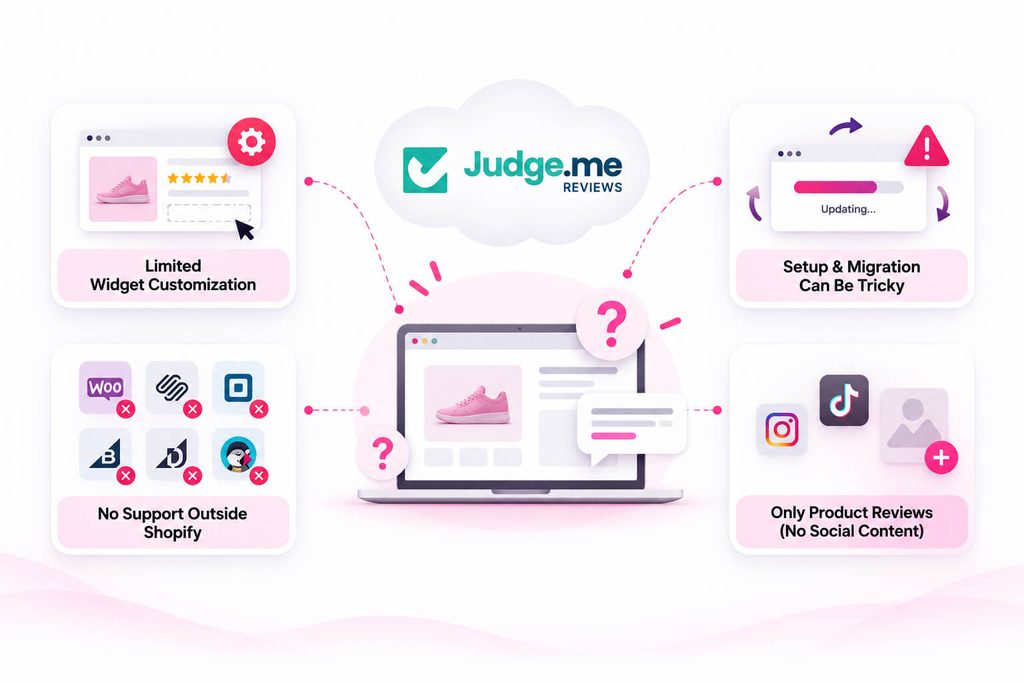
Judge.me covers the basics well and works fine for a straightforward review collection. But as your store grows, you may need to look for alternatives among current Judge.me competitors. Let’s see some common reasons merchants start looking for other options:
Judge.me’s approach: Widget templates are functional but fixed, especially on the free and entry-level paid plans. Getting a fully custom, minimalist look often means working around the default templates rather than configuring them directly.
What this means for you: If your brand needs a highly specific review layout, expect either a design compromise or additional dev time to force the review widget into your target look.
As of early 2026, Judge.me has fully discontinued support for WooCommerce, Squarespace, Square, BigCommerce, Duda, and PrestaShop, and now runs only on Shopify.
What this means for you: If you’re on any other platform, Judge.me is not your option. Export your review data before losing access, and note that imported reviews usually lose “verified” status and won’t count toward Google Shopping ratings on your new platform.
Occasional friction during setup, updates, and migration
Judge.me’s approach: Most day-to-day use runs fine, but issues arise at transition points. Theme updates don’t carry widgets over cleanly, imported reviews lose verified status, or review request emails go out with the wrong template before you finish customizing it.
What this means for you: The risk comes in the moments your store changes. For example, a new theme, platform migration or a bulk import.
Embeds reviews only (no broader social content aggregation)
Judge.me’s approach: Judge.me is built to do one core job: collecting and displaying product and store reviews tied to Shopify orders.
What this means for you: If you also want Instagram posts, TikTok content, or customer photos from social media pulled into a marketing wall or shoppable gallery, Judge.me cannot do it. You will need a second tool running alongside it, and that’s where a broader UGC platform like Taggbox becomes relevant.
Planning to migrate from Judge.me?
See how easily you can move your reviews to Taggbox with expert migration support.
Honest Analysis of Judge.me Reviews
Judge.me has around 46K+ reviews on the Shopify App Store, with mixed feedback distributed across 1- to 5-star ratings. Take a look at both sides of the coin before you make a decision of migrating:
What the positive reviews consistently praise:
- Fast, responsive support
- Simple setup, especially on Shopify Online Store 2.0 themes
- Strong value at the price point
What the negative reviews consistently flag:
- Migration and import issues: Reviews imported from other platforms sometimes lose “verified” status. One merchant reported nearly all imported reviews stripped of verification after switching back to Judge.me.
- Bugs at transition points: Theme updates, imports, and campaign launches surface glitches. Duplicate widgets show at once, review request emails go out with the wrong template, JavaScript errors after a customization request.
- Google Shopping sync limitations: Imported reviews (from platforms like Okendo) aren’t eligible for Google’s Product Ratings feed, even if they are verified somewhere else. Several merchants said this wasn’t made clear during migration.
- Support promises vs. follow-through: A recurring complaint: support says an issue is “escalated” or “fixed,” but the merchant reports the same bug persists.
- Data/tracking concerns: GDPR concerns were raised, saying that the app’s tracking pixel can’t be set to “optimised” mode without fully uninstalling, which the merchant argued conflicts with data minimization requirements.
“Our honest take: At a large number of four- and five-star reviews, dissatisfaction is a small minority. But one-star reviews are not random vague lash-outs. They point to specific, repeatable failure points: migrations, theme changes, and Google Shopping eligibility.”
Not sure which platform fits your needs best?
Talk to our experts
Eight Best Alternatives to Judge.me Comparison
| Pricing | Content Sources | Best for | Limitation |
| Judge.me | Starts free, scales up to $15/mo | Reviews only | Small Shopify stores that need basic star ratings and review collection | No social content aggregation even on the $15/mo plan, less customization options |
| Taggbox | Starts free, then $19/mo, scales up to $79/mo | 25+ social platforms & review sites | Brands needing reviews and broader social/UGC content. Offers 15+ platform feeds and 5,000 feeds for just $19/mo. | Not a dedicated review-collection tool, as it also collects UGC from social platforms |
| Yotpo | $89/mo, scales up to $169/mo | Reviews + UGC photos/videos | High-order-volume brands that can absorb premium review + loyalty pricing | Full feature set requires custom quotes and scales fast past entry tier |
| Bazaarvoice | Custom Pricing | Reviews + retailer syndication network | Large enterprise/retail brands that need reviews syndicated across multiple retailer product pages | Confusing UI with a real learning curve; heavy enterprise onboarding |
| Rivyo | Starts free, scales up to $19/mo | Reviews only | Budget-conscious Shopify stores wanting reviews, loyalty, and referrals together cheaply in one app | No multi-criteria/attribute reviews; no social/UGC aggregation beyond reviews |
| WiserReview | $14.25/mo, scales up to $61/mo | Reviews only, but imports from other platforms | Merchants specifically migrating off Judge.me who want a platform-agnostic tool | Narrower feature set; review-invite caps on lower tiers; not built for broader social UGC |
| Loox | Starts free, scales up to $299/mo | Photo/video reviews only | Shopify-only stores wanting polished, Instagram-style photo/video review galleries | Submitted reviews can’t be edited; text-only reviews don’t auto-trigger rewards |
| Stamped.io | Starts at $ 23/mo, scales up to $499/mo | Reviews + limited Instagram UGC | Mid-market brands wanting reviews, loyalty, and NPS bundled in one dashboard | Interface feels dated; many useful features locked behind higher tiers |
| Okendo | Starts at $105/mo, scales up to $1497/mo | Reviews + tagged social UGC | High-growth Shopify DTC brands needing deep structured review data (Attributes) feeding Klaviyo flows and ad creative | Dense, complex admin with a real learning curve; AI review summarization lags competitors; only pays off if attributes are actively configured and maintained |
Use Cases & Key Features of Judge.me Competitors
Taggbox
Use case: For brands that want reviews from multiple platforms including Google, Tripadvisor, Yelp, Airbnb, Amazon, AliExpress, and more along with custom review uploads. It offers features like AI review summariser & writer, AI moderation, review schema markup, QR code review collection, and multi-channel collection. Taggbox is also a great choice if you want reviews and social proof working together: UGC social walls, shoppable galleries, UGC rights, and hashtag campaigns
Key features:
- 25+ content sources
- Hashtag/mention campaigns
- Shoppable UGC
- AI-assisted moderation (TruSense)
- Embed on unlimited websites
- Review Schema Markup
- Analytics & insights with Google Analytics integration
Replace Judge.me with The Perfect Alternative
Signup Now
Did You Know?
The Leela, a luxury hospitality brand with 12 properties across India, used Taggbox to aggregate UGC from location-specific hashtag campaigns like #ExploreWithTheLeela.
The result:
- 100,000+ pieces of user-generated content collected
- 80,000+ social posts aggregated
- 15 million+ impressions
Read the complete case study: The Leela’s Winning UGC Strategy
Yotpo
Use case: DTC brands looking to manage reviews, loyalty, and SMS marketing from one platform. Best suited to stores with the order volume and budget to justify a full marketing suite. Reviews, loyalty, and SMS genuinely share customer data instead of living in three disconnected apps, which matters once a brand runs retention campaigns based on review behaviour.
Key features:
- Reviews with photo/video
- Loyalty & referrals
- SMS marketing
- Visual UGC galleries
- Shopify integration
If you’re comparing Yotpo alternatives based on broader UGC and social proof capabilities, it’s important to look at platforms that extend beyond review collection.
Bazaarvoice
Use case: Large enterprise or retail brands that need reviews syndicated across retailer product pages: Walmart, Home Depot, Costco and not just their own site. It’s effectively strong on retail review syndication. If a brand needs its reviews to appear on a big-box retailer’s product page, it is a good choice. But G2 reviewers consistently flag a confusing interface and a real learning curve. For a brand that only needs on-site reviews, this is significant overkill.
Key features:
- Retailer review syndication network
- Enterprise ratings and reviews management
- Influenster UGC/sampling community
- AI-based review prompts (HarmonyAI).
For brands exploring Bazaarvoice alternatives, it’s important to see if you need enterprise-level syndication or a more flexible platform for collecting and displaying reviews and UGC.
Rivyo
Use case: Budget-conscious Shopify stores that want reviews, loyalty, and referrals together cheaply. But it lacks multi-criteria/attribute reviews entirely, is Shopify-only, and its own branding stays visible on reviews until a paid plan is active.
Key features:
- Photo/video and text reviews
- Built-in loyalty & rewards
- Referral program
- Amazon/AliExpress import
- Google Shopping star sync
WiserReview
Use case: Merchants specifically migrating off Judge.me who want a platform-agnostic tool that preserves verified review status during import. It explicitly imports from Judge.me (plus Yotpo, Stamped, Loox, Google, and Facebook) and keeps the verified badge intact. It’s also the lightest-weight option tested for page-speed impact, alongside Judge.me itself. But the feature set is comparatively narrower by design: no loyalty, SMS, or attribute-based reviews, and review-invite counts are capped even on paid tiers below the Pro+AI plan.
Key features:
- Cross-platform review import with verified badges retained
- Photo/video reviews on every plan including free
- Works across Shopify, WooCommerce, Wix, Squarespace, and BigCommerce
- Location review forms (Google, Yelp)
- CSV export
Loox
Use case: Shopify stores wanting visually polished, Instagram-style photo/video reviews. It’s built around photo/video first, which makes it a strong fit for visual-first brands but can push others toward Loox alternatives with broader review capabilities. But submitted reviews can’t be edited once in, and it’s Shopify-exclusive, with no path to WooCommerce or anywhere else if the brand migrates platforms later.
Key features:
- Photo/video review requests
- Referral program
- Discount incentives for reviews
- Customizable review widgets/carousels
Stamped.io
Use case: Mid-market brands wanting reviews, loyalty, and NPS surveys in one dashboard. NPS survey functionality is a differentiator; none of the other apps here combine post-purchase reviews with broader customer-satisfaction scoring in the same tool. But a recurring theme in user reviews is that the interface feels dated, and several genuinely useful features (deeper analytics, more widget types) are unlocked at higher tiers than the entry price suggests.
Key features:
- Product reviews
- Q&A
- Loyalty & rewards
- Net promoter score surveys
- Limited Instagram UGC galleries
Okendo
Use case: High-growth Shopify DTC brands that need structured review data for ads and email, especially when product attributes like fit, size or quality drive purchase decisions. But the value only shows up if a team actively configures and maintains the attribute system. If left on default settings, it becomes like an expensive version of a standard review app.
Key features:
- Reviews with custom attributes/survey questions
- Klaviyo/ad platform data sync
- Quizzes
- Referrals
- UGC via Studio
Prefer to explore Taggbox on your own first?
Start free
Conclusion
As we’ve seen, migration is where Judge.me’s real friction shows up. Imported reviews losing verified status, Google Shopping eligibility gaps, theme/widget breakage, and support that does not always close the loop on fixes. If you’re already dealing with one of these, or outgrowing a reviews-only tool, you’ll need a plan for the switch.
So if you just want to consolidate reviews and social UGC into one platform or want a smoother migration than what you’ve experienced, feel free to have a word with the Taggbox team. We’ll walk through your current setup, flag anything that could break during the transition, and map out what a clean switch actually looks like for your store.